Monday, July 7, 2025
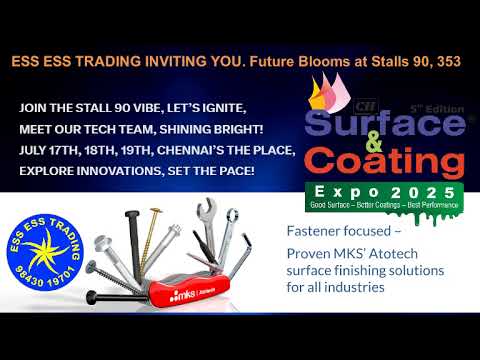
ESS ESS TRADING inviting to Surface Coating Expo 2025
Sunday, July 6, 2025
ESS ESS TRADING INVITING
Our expert technical team is ready to engage with you. They will provide deep insights into advanced surface coating technologies and customized solutions tailored to your needs. This is a great opportunity to explore innovations, discuss your requirements, and collaborate with us to drive progress in the industry.
சர்ஃபேஸ் கோட்டிங் கண்காட்சி உங்கள் முறை இதுவே!
ஜூலை பதினேழு வர்த்தக மையம் களைகட்டும்,
கோயம்புத்தூர் ESS ESS டிரேடிங், உங்களை அழைக்கிறது!
சர்ஃபேஸ் கோட்டிங்கில் ஒளிர்வோம், தீப்பொறி பறக்கும்!
புதுமைகள் நம்மை உயர்த்தும், மேலும் மேலும்!
MKS அடோடெக் ஸ்டால் தொண்ணூறுல் அழைக்கிறது,
excel laboratories முந்நூற்று ஐம்பத்து மூன்றுல், எல்லாம் நம்மிடம்!
ESS ESS டிரேடிங், உங்களை அழைக்கிறது!
MKS அடோடெக் ஸ்டால் தொண்ணூறுல்,
புது தொழில்நுட்பம் எக்செல் லேபரேட்டரீஸ்
முந்நூற்று ஐம்பத்து மூன்றுல், நிபுணத்துவம் ஒளிரும்,
புதுமை தொழில்நுட்பம்,
எதிர்காலத்தை மறுவரையறை செய்யும்!
சர்ஃபேஸ் கோட்டிங்கில் ஒளிர்வோம், தீப்பொறி பறக்கும்!
புதுமைகள் நம்மை உயர்த்தும், மேலும் மேலும்!
MKS அடோடெக் ஸ்டால் தொண்ணூறுல்அழைக்கிறது,
excel laboratories முந்நூற்று ஐம்பத்து மூன்றுல்,, எல்லாம் நம்மிடம்!
மூன்று நாட்கள் பிரகாசிக்க, தாமதிக்க வேண்டாம்,
ஜூலை மாதம் உயர பறப்போம்!
கோயம்புத்தூர் ESS ESS trading-இன் அன்பான அழைப்பு,
வர்த்தக மையத்தில் சந்திப்போம், எதிர்கால பயணத்திற்கு!
சர்ஃபேஸ் கோட்டிங்கில் ஒளிர்வோம், தீப்பொறி பறக்கும்!
புதுமைகள் நம்மை உயர்த்தும், மேலும் மேலும்!
MKS அடோடெக் ஸ்டால் தொண்ணூறுல் அழைக்கிறது,
Excel laboratories முந்நூற்று ஐம்பத்து மூன்றுல், எல்லாம் நம்மிடம்!
வாருங்கள், புதுமைகள் படைப்போம் ,
ESS ESS trading உண்மையாக வழிநடத்தும்,
சர்ஃபேஸ் கோட்டிங் கண்காட்சி,
எதிர்காலம் உங்களுடன் தொடங்கும்!
MKS அடோடெக் ஸ்டால் தொண்ணூறுல் அழைக்கிறது,
Excel lab முந்நூற்று ஐம்பத்து மூன்றுல் அழைக்கிறது!
கோயம்புத்தூர் ESS ESS trading-இன் அன்பான அழைப்பு,
வர்த்தக மையத்தில் சந்திப்போம், எதிர்கால பயணத்திற்கு!

Friday, March 21, 2025
Ess ESS Trading Authorised distributor for Atotech India Pvt Ltd Location map
Our Billing address and GSTN
ESS ESS TRADING
81,Visveshwara Nagar,
Vilankurichi, Coimbatore - 641035
GST No: 33AHCPG6209J1ZM
Location Map: Click here to view location map
https://maps.app.goo.gl/4eYnHSpYpwGxNyWDA
Our official Transport:
ACPL Avinash Cargo Click here to contact ACPL
Book all materials on door delivery basis.
Saturday, February 22, 2025
Atotech Modern Cleaners: Shaping the future of sustainable industrial cleaning.
Tuesday, December 17, 2024
Ess Ess Trading
Regional Excellence award 2023 @mksinstruments #atotech pic.twitter.com/fitaMqD1k3
— Ess Ess Trading (@essesstrading) February 6, 2024
Sunday, December 1, 2024
The Future without hexavalent Chrome
Tuesday, November 26, 2024
Stannatech 2100 : Revolutionizing Immersion TIN Platingfor next-gen Performance
Immersion tin plating is a displacement reaction process where copper is dissolved during the deposition of tin, forming a tin layer directly on copper. This process creates a copper-tin intermetallic compound (IMC) that is crucial for soldering applications. Immersion tin layers are particularly attractive in the PCB market due to their robustness, long shelf life of at least 12 months, and absence of nickel, making them suitable for high-frequency applications. Additionally, immersion tin is more corrosion-resistant compared to other finishes, which is beneficial for automotive applications and offers a lower cost alternative to precious metal finishes.
Properties and Benefits of Stannatech 2100
The Stannatech 2100 immersion tin electrolyte introduces several enhancements over existing immersion tin solutions. Key benefits include:
- Reduced Viscosity: The new formulation significantly lowers the viscosity of the immersion tin solution, improving solution exchange and rinsing capabilities, especially in narrow features.
- Improved Soldering Performance: The Stannatech 2100 demonstrates better solder wetting characteristics, achieving lower spreading angles in solder spread tests compared to reference processes.
- Compatibility with Auxiliary Equipment: The process is designed to work seamlessly with existing auxiliary equipment, such as the constan and crystallizer, which help maintain consistent plating conditions and extend the bath life.
Typical Defects in Immersion Tin Plating
Despite its advantages, immersion tin plating can present certain risks and defects:
- Whisker Growth: Caused by the formation of intermetallics during aging, leading to stress and potential whisker formation.
- Copper Diffusion: The absence of a barrier layer allows copper to diffuse through the tin layer, limiting the shelf life of the finish.
- High Ionic Contamination: Poorly cured solder masks can absorb immersion tin chemistry, leading to high ionic contamination levels.
Key Improvements with Stannatech 2100
The Stannatech 2100 addresses several limitations of previous immersion tin processes:
- Enhanced Solution Exchange: The reduced viscosity allows for better solution exchange, preventing excessive copper dissolution and corrosion in narrow areas.
- Improved Rinsing: The lower viscosity facilitates easier rinsing, reducing drag-out of plating chemistry and minimizing ionic contamination.
- Lower Undercut Risk: The process shows a significant reduction in undercutting of solder masks, enhancing overall finish quality.
Soldering Performance Tests
Various soldering performance tests were conducted to evaluate the effectiveness of the Stannatech 2100:
- Solder Spread Test: Results indicated that the Stannatech 2100 achieved lower spreading angles, indicating better solder wetting compared to reference processes.
- Wetting Tests: The Stannatech 2100 consistently performed better in wetting tests, demonstrating superior solderability across different aging conditions.
- Dewetting Tests: The new process showed no failures in dewetting tests, indicating strong solder connections.
Root Causes of Soldering Defects
Common soldering defects associated with immersion tin can often be traced back to:
- Residues on Copper: Contaminants not removed before the tin plating can interfere with IMC growth and solder wetting.
- Inadequate Rinsing: Insufficient rinsing after the immersion tin process can leave residual chemistry that affects solderability.
- Volatile Contaminants: Volatiles from poorly cured solder masks can evaporate during reflow, leading to defects.
Post-Treatment Solutions
To further enhance the performance of immersion tin layers, several post-treatment solutions are available:
- Ionics 2100: Reduces ionic contamination, particularly important for automotive applications.
- Tin Post Treatment 8: Prevents yellowish discoloration of the immersion tin layer after reflow aging.
- Tin Post Treatment 2020: Strengthens the oxide layer, reducing the risk of dewetting defects.
Conclusion
The Stannatech 2100 immersion tin plating process represents a significant advancement in PCB manufacturing, addressing common challenges associated with traditional immersion tin methods. With its reduced viscosity, improved solderability, and compatibility with existing equipment, the Stannatech 2100 is poised to meet the evolving demands of the electronics industry, particularly in high-performance applications such as automotive and high-frequency devices.
As the industry continues to seek solutions that enhance reliability and performance, the Stannatech 2100 stands out as a promising option for next-generation immersion tin plating.
We at ESS ESS TRADING provide complete service and supply of chemicals in India . Contact us : Email: info@essesstrading.in Mobile: 9843019701
Friday, November 15, 2024
New Development in EN Corrosion Protection
This blog post discusses the latest developments in high phosphorus electroless nickel coatings, focusing on their superior corrosion protection capabilities compared to traditional methods. It covers the importance of coating thickness, the impact of porosity, and the evaluation methods used to assess corrosion resistance.
For more details and purchase mks Atotech Products
Contact us -Email: info@essesstrading.in Mobile: 9843019701
In a recent webinar, experts presented significant advancements in high phosphorus electroless nickel (EN) coatings aimed at improving corrosion protection. This post summarizes the key points discussed, including the importance of corrosion protection, the evaluation methods for coatings, and a comparison of new processes against existing technologies.
Understanding Corrosion Protection
Corrosion protection is crucial for extending the lifespan of components exposed to harsh environments. Electroless nickel coatings are particularly valued for their wear resistance and corrosion resistance. Unlike traditional electrolytic processes, electroless nickel coatings are deposited uniformly without the influence of current density distribution, resulting in consistent thickness across complex geometries.
Importance of Uniform Thickness
The uniformity of electroless nickel coatings is a significant advantage. For instance, the thickness variation in electroless nickel coatings is typically less than five percent, even in deep recess areas. This uniformity is essential for ensuring effective corrosion protection, as demonstrated by the comparative analysis of electroless and electrolytic nickel coatings.
Mechanism of Corrosion Protection
Electroless nickel coatings provide corrosion protection by encapsulating the substrate, forming a barrier layer that prevents corrosive elements from reaching the underlying material. The nickel-phosphorus layer is inert to many corrosive conditions and forms a strong oxide layer that further protects the surface.
Factors Affecting Corrosion Resistance
The effectiveness of corrosion protection is influenced by several factors:
- Surface Preparation: A defect-free substrate is critical. Inclusions from casting or fabrication processes can lead to defects in the coating.
- Coating Thickness: Thicker coatings generally provide better protection. For example, a thickness of 75 microns is recommended for extreme environments, while 20 to 30 microns is typical for automotive applications.
- Operating Parameters: Bath filtration, agitation, and the use of appropriate raw materials are essential to minimize defects during the plating process.
Evaluation Methods for Corrosion Resistance
To assess the corrosion protection of electroless nickel coatings, several testing methods are employed:
- Peroxide Test: This test reveals pores in the coating by reacting iron ions with potassium hexacyanoferrate.
- Salt Spray Tests: Various salt spray tests, including neutral, acetic acid, and copper accelerated acetic acid tests, are used to evaluate the corrosion resistance under different conditions.
- Water Climate Test: This test simulates corrosive environments by using sulfur dioxide to accelerate corrosion.
Correlation Between Thickness and Porosity
Research indicates a direct correlation between coating thickness and porosity. For instance, coatings around 30 microns thick exhibit near-zero porosity, which is crucial for effective corrosion protection. The presence of pores can lead to substrate corrosion, especially in moist environments.
New Developments in Electroless Nickel Processes
The webinar highlighted the introduction of the Nikem HP 1170 process, which offers enhanced corrosion protection through improved formulation and process parameters. Key features include:
- High Phosphorus Content: The process achieves a phosphorus content of 10 to 12 percent, enhancing corrosion resistance.
- Compressive Stress: The new process maintains compressive stress throughout the bath life, contributing to the durability of the coating.
- Environmental Compliance: The formulation is free from toxic heavy metals, aligning with environmental regulations.
Performance Comparison
In comparative tests, the Nikem HP 1170 process outperformed previous generation processes in terms of corrosion resistance. For example, panels coated with Nikem HP 1170 showed no red rust after extensive exposure in salt spray tests, demonstrating superior performance over traditional methods.
Conclusion
The advancements in high phosphorus electroless nickel coatings represent a significant leap forward in corrosion protection technology. By focusing on uniform thickness, minimizing porosity, and utilizing innovative processes like Nikem HP 1170, manufacturers can achieve enhanced durability and longevity for components in corrosive environments. As the industry continues to evolve, these developments will play a crucial role in meeting the demands of various applications, from automotive to marine environments.
ESS ESS TRADING inviting to Surface Coating Expo 2025
We are pleased to invite you to CII India Surface Coating Show 2025, which will take place at the Chennai Trade Centre, C...
-
pic.twitter.com/jZLuEPJGFn — Ess Ess Trading (@essesstrading) December 27, 2020
-
We supply Atotech Cupracid ultra Part A, Cupracid ultra Part B, Cupracid ultra makeup, Cupracid leveller addtive and Cupracid wetting agent....
-
To buy this product at the Price Rs 350 including GST Click Here . We supply high purity electroplating grade Copper Sulphate. 99.99...